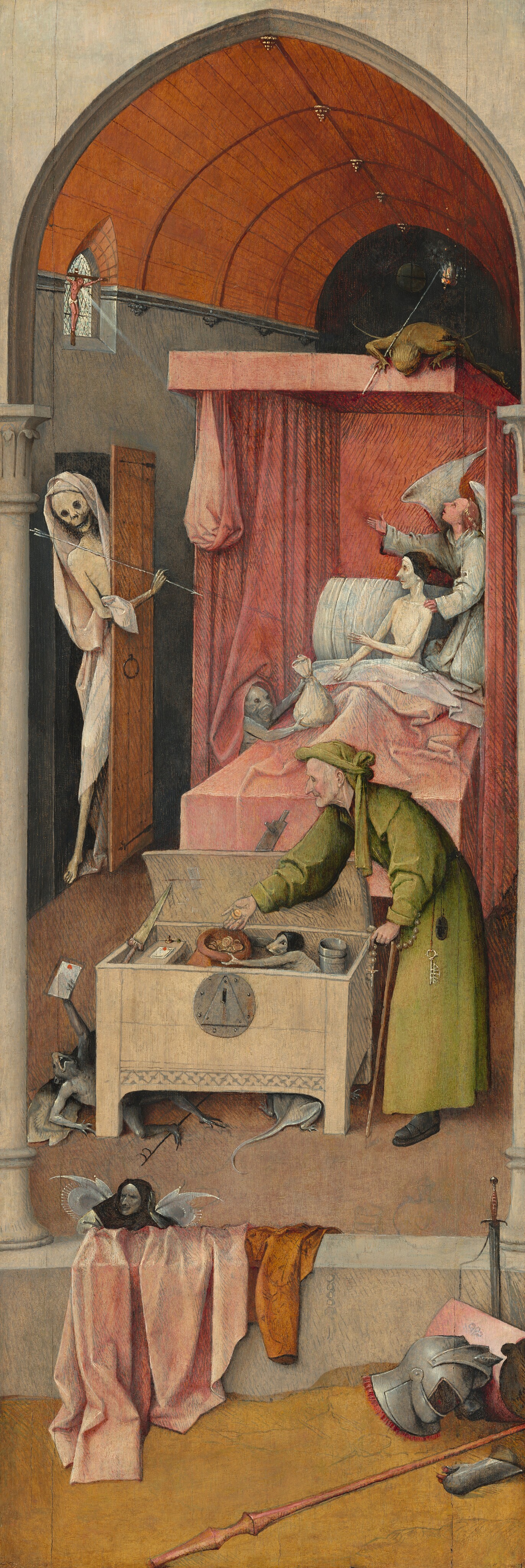
Death and the Miser · Hieronymus Bosch · National Gallery of Art
When a writer sells us a story, we pay the professional rate: eight cents a word, on acceptance. A five-thousand-word story earns four hundred dollars. The number is a choice, and the choice means something, so I want to say plainly what.
The small press is the bloodstream of this genre.
The going rate for original horror online is often twenty-five dollars. Sometimes it is a flat fifty. Sometimes it is a contributor copy and a byline and nothing else. I am not here to indict those markets. Most are run by one or two people who love the form, working past midnight on margins that would frighten an accountant, and a good many of the writers I admire got their first acceptance from exactly that kind of publication. The small press is the bloodstream of this genre. Pull it and the rest of us go pale.
We decided Deep Cut would not run on that hope.
But I want to be honest about the arithmetic. Twenty-five dollars for a five-thousand-word story is half a cent a word. Half a cent against eight. At that rate the payment is not compensation; it is a gesture, a token of thanks, and everyone in the transaction knows it. The writer is being paid in something other than money: in exposure, in the line on the résumé, in the hope that this one leads to the next one. Those things are real. They are not rent.
It is the number the field uses to mark the line between a hobby and a profession
We decided Deep Cut would not run on that hope. Paying the professional rate is not generosity, and we would be embarrassed to have it read as charity. It is a valuation. It says the story is worth something the moment we accept it, before a single reader has seen it, before anyone knows whether it will be remembered. Eight cents a word is what the Science Fiction and Fantasy Writers Association calls its professional rate, and it clears the Horror Writers Association's professional threshold with room to spare. Call it whatever you like. It is the number the field uses to mark the line between a hobby and a profession, and we pay it because the work on this side of the line deserves to be treated as work.
There is a second thing the number says, and it is the one I care about most. Deep Cut is free to read. The stories sit on the site for anyone who wanders in: no account, no wall, no email, nothing. We made that choice and we made the choice to pay professionally in the same breath, because they are one conviction pointed in two directions. The reader is never charged to read. The writer is paid in full. The cost of both lands on us, where it belongs. A magazine that asks nothing of the reader and pays the writer properly has to stay honest with itself about what it is for, and I would rather answer that question every quarter than learn to dodge it.
It helps pay the next writer eight cents a word.
Everything past the stories is optional. A free account costs an email and brings the work to your inbox the day it goes live; it also hands you Issue Zero, the preview we built to show you what this is before the first full issue lands, and it opens the comments, because a magazine that takes horror this seriously should want the argument. Beyond that there is a paid edition: the full issues typeset and yours to keep, in PDF and EPUB. All of that for $10/year. They are painstakingly laid out and gorgeous. They have additional paid artwork and photography. That money buys you nothing the free reader does not already have, because the stories were never locked. What it does is quieter and better. It helps pay the next writer eight cents a word.
We also pay on acceptance, not on publication. That is not a footnote. Plenty of markets pay when the issue ships, which can be months out, and some issues never ship at all. Paying on acceptance means the writer is paid for the decision we made, not for the calendar we keep. The risk in our timeline is ours to carry, not theirs.
If you are a writer deciding where to send the best thing you wrote this year, you should know what we think it is worth.
None of this makes us better than the markets paying twenty-five dollars. It makes us different, and the difference is one we would like to be legible. If you are a writer deciding where to send the best thing you wrote this year, you should know what we think it is worth. If you are a reader, you should know that the people who wrote the stories you are reading for free were paid like professionals to write them. And if you want to see what that buys before you take my word for it, Issue Zero is waiting. It costs you an email.
That is the going rate here.
Ash
Login to see the download links for Issue Zero