Six features in a decade invites a tidy story, and the tidy story is a climb. An obscure debut stuck in distribution limbo, a streaming curio, an unseen fairytale, then the breakout, then two films in a single year. Read that way, Osgood Perkins looks like a director who spent ten years learning to be commercial and finally cracked it. The more honest shape is not a climb but a pendulum, and Keeper is the swing back.
Osgood Perkins looks like a director who spent ten years learning to be commercial and finally cracked it
Start at the beginning, because the whole sensibility is already there. The Blackcoat's Daughter was shot and shown in 2015 under the title February, though distribution trouble kept it from a wide release until 2017. It is the most accessible thing Perkins has made and also the clearest statement of intent: a Catholic boarding school, two timelines braided so quietly you feel the join before you see it, a possession story built on dread rather than shock. His brother Elvis scored it. The slasher furniture is all present, and all of it is wired to something colder and more interior than a slasher wants. This is a filmmaker who took a genre about bodies and made it about waiting.
This is a filmmaker who took a genre about bodies and made it about waiting.
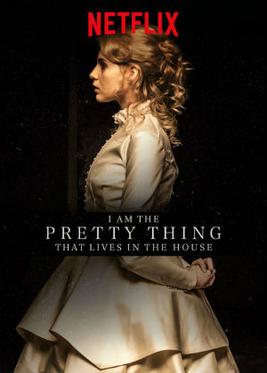
Then, in 2016, the thesis film. I Am the Pretty Thing That Lives in the House went straight to Netflix and split its small audience clean down the middle, and it remains the truest map of what Perkins actually does. One house. One year. Ruth Wilson mostly alone, a hospice nurse in a stark New England farmhouse, narrating in a literary register somewhere between Shirley Jackson and a nineteenth-century murder ballad. The narrator announces her own death in the first minutes and the film simply walks toward it. Mold creeps the walls. A retired horror novelist keeps calling the nurse by the name of a dead woman from her most famous book, and slowly the living woman folds onto the murdered one until you cannot tell which of them is telling the story. The recurring complaint about Perkins was born here fully formed: barely enough plot for a short, all mood, a single note held past comfort. What most reviews missed was the personal undertow. He has said the film grew partly out of trying to reach his dead father, the actor Anthony Perkins, and once you know that, the whole thing reads as a seance. This is his true north. Everything after either honors it or flees it.
...once you know that, the whole thing reads as a seance
For a while he fled it slowly. Gretel & Hansel in 2020 was a lush, formalist reworking of the fairy tale, gorgeous and nearly invisible, a cult object more than a release. Then a four-year gap. If the career had ended there, Perkins is a boutique mood-horror director with a devoted following of a few thousand people, and the tidy climb story never gets written.
What ended the gap was not a change of sensibility but a change of packaging. Longlegs, in 2024, is the same dread engine bolted to a hook. An occult serial-killer procedural set in the nineties, Nicolas Cage buried in prosthetics as a Satanic murderer the marketing refused to show, Maika Monroe as the stony FBI agent chasing him. Neon ran a guerrilla campaign closer to The Blair Witch Project than to a modern studio rollout: coded messages, a stunt clip of Monroe's spiking heart rate, hidden devils seeded through the frame for fans to hunt. It worked to the tune of roughly 128 million dollars on a budget under ten, the highest-grossing independent film of the year. The important thing is what the film taught its director. Perkins's register sells, in volume, provided you give it a villain, a plot, and a face the campaign can withhold. The dread was still his. The hook was new.
Perkins's register sells, in volume, provided you give it a villain, a plot, and a face the campaign can withhold.
The Monkey, eight months later, was the pendulum at its far extreme. A gory Stephen King adaptation played as horror-comedy, a junk drawer of darkly ridiculous carnage, Tatiana Maslany's first film with Perkins. Loud where Pretty Thing was hushed, plotted where Pretty Thing withheld, funny where Pretty Thing was a held breath. Neon reportedly fumbled the campaign this time, leaning on the Longlegs playbook for a film that needed a different one. Whatever you make of it, and reactions run hot in both directions, it is the least like the man who made the ghost-narrated house movie. Two films, one year, and Perkins had gone as far from himself as the market would carry him.
Two films, one year, and Perkins had gone as far from himself as the market would carry him.
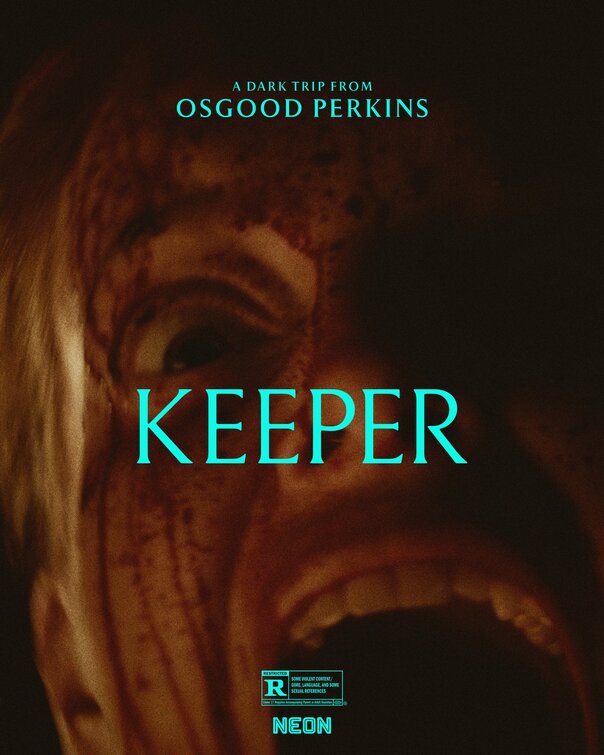
Which is what makes Keeper worth taking seriously as more than a new release. A couple drive to a secluded cabin for their one-year anniversary. There is a cake left by a caretaker. There is a cousin next door and a girlfriend who vanishes into the trees. When the boyfriend leaves for town, the woman is alone in a house whose geography never quite resolves, an Overlook where the doors do not add up. Underneath it runs a folk substrate, an incubus, a centuries-old murdered woman whom the living woman turns out to double and, in some sense, reincarnate. The echoes to Pretty Thing are neither subtle nor accidental: the isolated domestic space as the entire world, the present woman collapsed onto a dead predecessor, the ballad logic of a woman taken to the woods to die, dread privileged over incident, and the same divided verdict waiting on the other side, mixed reviews, an ending audiences argue about, and the recurring accusation that it is all style and no substance. Critics reached, almost in unison, for the word return.
Here is the fact that complicates the return, and it is the one most retrospectives skip. Keeper is the only feature in this run Perkins did not write. It was scripted by Nick Lepard, a Canadian writer brought in during the 2023 strike precisely because he sat outside the Writers Guild, and it was shot quickly in Vancouver while The Monkey was stalled by the same labor stoppage. Keeper is, in the plainest terms, the film Perkins made because it was the film that could be made when nothing else could. So the homecoming is real but overdetermined. Part of it is instinct and part of it is the accident of what was shootable in a dead season. The most Perkins-like film of his recent output is the one he did not author on the page, and that should tell us where his sensibility actually lives. Not in the writing. In the filming. In the withholding. In the decision to point a camera at a house and refuse to explain it.
Keeper is the film Perkins made because it was the film that could be made when nothing else could.
Two readings follow, and both are fair. The generous one: unhooked from Cage and King and Neon's marketing machine, Perkins does the only thing he was ever really doing, which is to turn a house into an engine for repeating a woman's death, and Keeper is him at home. The unforgiving one: Keeper is the rut beneath the range, evidence that without a villain or a gimmick the mode thins out to atmosphere and a woman wandering a dark set, and the mixed reviews are measuring a genuine limitation rather than an audience too impatient for slow burns. I lean toward the first while granting that the second has the receipts. What is not in dispute is the direction of travel. Handed a gap and a free hand, Perkins did not push forward. He went back to the house at the end of the road.
Every filmmaker has a home register. His is a quiet house with a dead woman in the walls and no intention of telling you why.
And he has already left it again. Nicole Kidman's The Young People has wrapped, a new film set in the Longlegs universe is set up at Paramount with Cage, and Neon is in the rearview. The pendulum will keep swinging, because it always has. But Keeper is the useful data point, the film that shows you what Perkins defaults to when the market is not in the room. Every filmmaker has a home register. His is a quiet house with a dead woman in the walls and no intention of telling you why. Keeper is him coming back to keep it, for better and for worse.