On Sundays She Picked Flowers · Saga Press, 2026
There is a knife on the second page of this book and a body on the twentieth, and if you are the kind of reader who thinks that settles the question of what you are holding, Scholfield would like a word. On Sundays She Picked Flowers opens the way a slammed door opens a house: all at once, no threshold, the reader already inside. Judith Rice is forty-one, and her mother has just cracked her skull against a wall for the crime of talking back, and the quilting circle in the next room glances at her crumpled body and goes back to its needles. That apathy is the wound the whole novel is dressed around. Jude will kill her mother in the kitchen before the first act is out, and the astonishing thing Scholfield manages is that this is not the climax of anything. It is the door. Everything true about the book waits on the other side of it.
That was the role and she performs the killing that ends it in a state closer to grief than triumph.
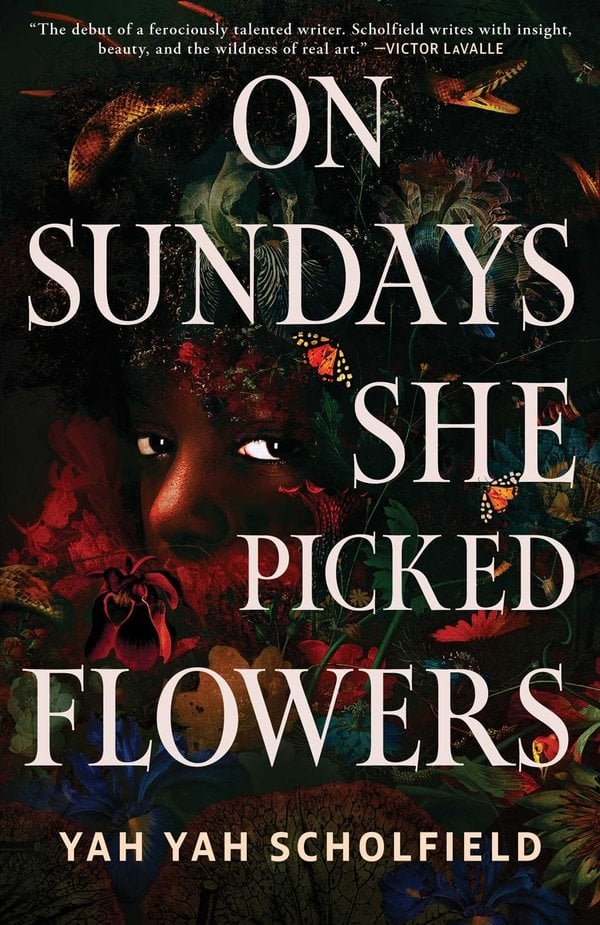
A casual reader perusing this book cover might flatten this into a matricide novel and a Southern Gothic revenge object,but it is so much stranger than that. Scholfield has written a book about what a person is for after the one thing they were kept alive to be is finished. Jude was a whipping girl. That was the role and she performs the killing that ends it in a state closer to grief than triumph. She washes in her dead mother's tub. She slips the gold band off the cooling finger and onto her own. Then she gets in the car and drives southeast because she likes the names on the map, and the novel exhales into something unexpected: a long, green, haunted becoming.
Then the beast comes to the door wearing a woman.
The house is where the book locates its soul. Bette, a white girl at a Whitnee inn who is as cruel and as bored as her circumstances made her, sends Jude into the Okefenokee toward a farmhouse nobody will touch. It was a plantation once. Two Black women lived there after, free or escaped, and the town got up a posse over rumors of witchcraft, and the women vanished without leaving so much as a shoe. What is left is a house full of haints, a cellar with a prayer closet and a working altar, and a presence that churns and reels as Jude walks its halls because it is deciding, in real time, whether to keep her. Scholfield gives the house its own interludes, a first-person-plural murmur of the dead sizing up the intruder, and the choice pays off the way the best formal risks do: it turns the haunting from atmosphere into a second consciousness. Is she one of us? the haints ask. Something like it, the house answers, but neither really knows. They name her Little Sister and plant her in the field like a crop and she comes up green, chlorophyll in her arteries. Jude is not being terrorized by this house. She is being adopted by it.
Then the beast comes to the door wearing a woman.
Nemoira is the novel's masterstroke, and I am going to try to talk about her without unmaking the pleasure of watching her arrive. She presents as a lost traveler, tall and wrong-bodied and hungry, pronouncing Jude's name with a whistle through her teeth, and the two of them fall into a courtship conducted almost entirely through food and heat and the careful watching of each other's faces. Scholfield writes desire ethereally and magnetically, which is worth saying because horror so often does desire as threat. There is a bath scene in the middle of this book, all steam and jasmine and Jude fleeing the room three times to keep from touching the woman in the water, that is as charged as anything I have read this year, and the charge is tenderness, not menace, even though the reader already suspects what Nemoira is. That suspicion is the point. Scholfield lets you love the monster before the monster is confirmed, so that when the bill comes due you are as compromised as Jude is.
And it does come due. The book is unsentimental about what love between two predators costs, and about who does the killing, and about the fact that killing the beloved is not the same as being free. The 1990 coda, twenty-five years on, is where Scholfield collects on the emotional debt the novel has been quietly running up. Jude, aged, one-eyed, sixty-six and spry, still picks flowers on Sundays, still tends the house, still sews a story quilt out of a life. What waits for her on the porch I will not say. What I will say is that the last movement of this book argues that a person is not unmade by the violence done to them or the violence they do. Jude keeps insisting on her own humanity right through the final pages, against a lover who would rather she be something grander and less human, and the book takes her side. She is a person. She did a monstrous thing and monstrous things were done to her and she is, still, a person, worthy of the word. That is a harder and rarer claim than damnation.
That argument is the book's moral engine, and Scholfield is honest enough not to resolve it cleanly.
I have omitted the aunts, and I should not, because the two chapters where Vivian and Phyllis wash and shroud and bury their murdered sister are among the finest sustained writing in the book. The whole middle of the novel widens to hold them, and it is here that Scholfield's real subject surfaces: not one woman's rage but the inheritance of it, the violence stitched into a family across generations like a pattern in a quilt. There is a revelation about Jude's parentage, delivered late by the cruelest aunt in the ugliest possible moment. Ernestine's coldness, the missing photographs, the absent father, the grandmother's ring passing from cold hand to warm one down the years. It is a gut-punch, but Scholfield refuses to let it function as simple twist. The aunts get a whole argument about it, Phyllis insisting there is no such thing as a bad seed, only dry and unkind land, Vivian unable to say where she is supposed to put the anger and the love now that the sister who held both is dead. That argument is the book's moral engine, and Scholfield is honest enough not to resolve it cleanly.
If I have a reservation, it is one of density rather than fault. The prose runs hot and baroque, image piled on image, and there are stretches, particularly in the fever chapters, where the accumulation of the visceral starts to blur rather than sharpen. Scholfield's sentences are gorgeous nearly all the time, which means the reader loses a little of the calibration that would make the truly unbearable images land harder. A cooler passage or two would have made the hot ones hotter. But this is the reservation of a reader who wanted the knife kept keener, not one who found it dull, and I would rather have a debut this unwilling to look away than a tidier book with less nerve.
On Sundays She Picked Flowers is a book about a haunted house that turns out to be a book about how a person becomes a home. It is grotesque and lush and, in its final movement, almost unbearably tender. It will not be for everyone, and Scholfield has done you the courtesy of saying so on the copyright page. For the reader who can walk into that kitchen and keep going, past the body, down into the cellar where the candles are lit and the dead are fed, there is a love story waiting. This one has a great many edges, and every one is sharp on purpose.
Deeper Cuts
Every review here ends in the stacks. These are related works that share a particular wound, for when you end the story and you are not ready to leave the dark yet.
If the house that keeps you got its hooks in. Scholfield's Candle is a haunted house that adopts; a home built on Black blood that chooses to shelter the woman who come to it broken. For the haunted-house-as-inheritance, reach for The Reformatory by Tananarive Due, where a Jim Crow Florida reform school is thick with the ghosts of the boys it killed and the living and the dead are equally bound to the land that took them. Pair it with White Is for Witching by Helen Oyeyemi, a house that eats its women and speaks in its own voice, xenophobic and hungry and impossible to leave, the closest cousin I know to Scholfield's murmuring haints.
If loving the monster got its hooks in. The heart of this novel is a courtship between two things that eat, and its refusal to let either partner off the hook of what they are. For the beloved who is also the predator, read Her Body and Other Parties by Carmen Maria Machado, where desire and dread share the same skin and the women are never asked to be safe to be loved. Then take up Sorrowland by Rivers Solomon, another story of a Black woman fleeing into the woods, transforming into something other than human, and discovering that the monstrous body is also a body that survives.
Disclosure: the book links above are Bookshop.org affiliate links. Buying through them sends a small commission to Deep Cut Press and an equal share to the indie-bookstore fund, at no extra cost to you.