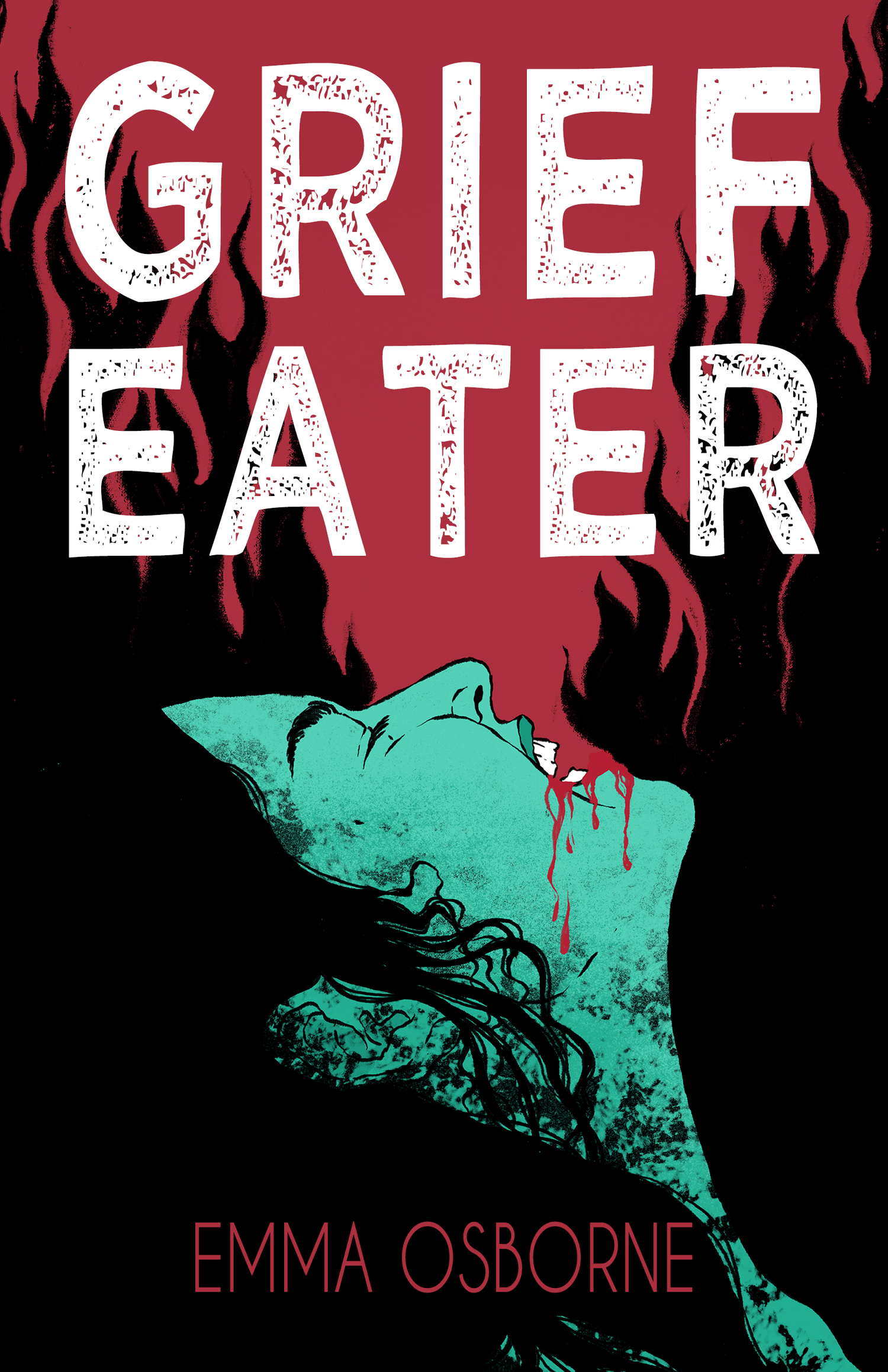
Grief Eater
I read Grief Eater in a single sitting, on a night I had set aside for something gentler, and when I finished I did a thing I have not done after a book, maybe ever: I picked up my phone and called someone I love. Not because the novella is warm. It is one of the coldest things I have read this year. I called because Emma Osborne spends the whole of this short, savage book making the case that the call you do not make is the wound you carry into the ground, and I did not want to be carrying mine when I put the lights out. That is what this book does. It reaches past the apocalypse it is wearing and finds the unmade phone call, the unsaid word, the love that never came, and it presses there until something gives.
On its surface Grief Eater is a zombie story, which is to say it is not a zombie story at all. The dead in Osborne's Melbourne, named Naarm throughout, are not the shambling extras of the genre. They are fast, they are strong, and a rare few of them wake up still themselves. Kristina dies in the first paragraph, bitten in an alley behind her old library, and rises into a body that has shed its pain and kept every scrap of its memory. The cruelty of the conceit, and it is a gorgeous cruelty, is in what feeding does to her. When she eats, she tastes the life she is ending. The songs and the gas bills and the grandparents, yes, but above all the love. Her first kill is a firefighter hauling a bag of spoiled tins he will not drop, and only when his blood is in her mouth does she understand why: the food was for his daughter, Alice, and the man's love for that little girl floods into Kristina like light into a room that has never had a window. She has never been loved like that. She can taste that nearly everyone else has been. That is the engine of the book, and it is merciless. A woman who can sample the tenderness inside every stranger she kills, walking home across a dead country to learn whether there was ever any tenderness in the people who made her.
This is a debut that reads like a fifth book.
This is a debut that reads like a fifth book. Osborne writes the body better than almost anyone working in this register. The prose is built out of smell and taste and weight: the heave of wet denim peeled off in the rain, the scent of "dying cells, coagulation, and spinal fluid" that means kin, a mulberry eaten off a fallen tree that tastes of a whole childhood at once. The narrator's senses are dialed past human, and Osborne uses that not as a party trick but as a grief delivery system. Every meal is an act of unwilling empathy. The Australianness is not set dressing either; it is the grain of the thing, plane trees scattering pollen over bare tram tracks, bluestone worn now by rain instead of footfalls, party pies on a cardboard plate at a country wake. And the wake itself, Aunty Jill's funeral, is one of the finest set pieces of queer grief I have come across: Tina Turner on the speakers because the dead woman asked for it, a drag queen named Hella Goodtime singing Dolly into a dusty hall while the narrator's parents mutter from the good seats. Osborne lets the scene be funny, which is much harder than letting it be sad, and the comedy is what makes the sorrow land.
...no incident occurred from which his rage and misery could not extract its food.
The book opens under an epigraph from Frankenstein, the creature speaking: no incident occurred from which his rage and misery could not extract its food. It is the right key to play the whole novella in. This is a made monster, abandoned and unloved, learning that its hunger and its grief are the same appetite. Osborne knows exactly what they are doing with that lineage, and the knowing never curdles into homage. Kristina is her own creature, country-raised and city-saved, queer in a family that beat her for it, kept alive by a chosen family, by Josh most of all, who picked up the phone every time, and by an aunt brave enough to put a rainbow sticker on her car. The two families are the real binary the book runs on. The one you are born into, which here is a furnace of slaps and burns and cigarette smoke and indifference, and the one you build, which is the only warmth in the book and is mostly offstage, mostly remembered, mostly gone.
It is not a perfect debut. The architecture alternates with great regularity, a chapter of the hungry present against a chapter of the human past, and after a while you can feel the metronome. Worse, now and then Osborne does not trust the image and tells you what it meant. The mother prunes her roses brutally and the narrator gives us "a deep cut and then new life to follow," which is a fine line, and then the book keeps explaining that cut, as if afraid we missed it. Near the end Kristina says outright that the answers she found were the ones she carried all along, which is true and devastating and also a sentence the preceding hundred pages had already made unnecessary. There is a version of this novella that trusts its reader the way it trusts its nose, that lets the rose stand without the gloss, and it would be a quieter, harder, even better book. When your sensory writing is this confident, the thematic underlining reads like a lack of confidence.
There is a version of this novella that trusts its reader the way it trusts its nose, that lets the rose stand without the gloss, and it would be a quieter, harder, even better book.
I came to the last chapter braced for the book to flinch where it counts, and it does not. I will not walk you through the ending, because the shape of it is the experience and I want you to meet it cold. I will only say that Osborne understands the single thing most revenge stories refuse to learn, which is that the door you have walked toward your whole life can open onto an empty room, and that the emptiness is the point. Kristina has spent the book tasting love in the bodies of strangers. The final question is whether she will find any in the one body she came home for, and Osborne is brave enough to send her looking and braver still to let the cupboard be bare. The search is the most harrowing thing in the book and I docked it nothing for being plain, because by then it had stopped being plain and started being unbearable. Revenge does not heal her. The book says so, and I had been ready to mark it down for saying so, and then it showed me a daughter taking her mother apart in search of a single remembered minute of herself, finding not even the memory of her own birth, and I stopped keeping score.
So: a debut of real and frightening control, occasionally too eager to translate its own symbols, and unflinching exactly where flinching would have been forgivable. The hunger in this book was never for blood. It was for proof of having been loved, and Osborne lets their monster hunt that proof all the way down and lets the hunt come up empty, and somehow makes a terrible mercy of the emptiness. It has stayed with me in the specific way of a book that names a fear I keep folded small and carry everywhere. I made the call. I would read this first, and then make yours.
Deeper Cuts
Every review here ends in the stacks. These are related works that share a particular wound, for when you end the story and you are not ready to leave the dark yet.
If the unanswered phone got its hooks in:
Sharp Objects, Gillian Flynn. The other great anatomy of a daughter who cannot stop cutting herself open to find out what her mother is made of. Flynn's Camille carves words into her own skin the way Kristina digs through bodies for a memory of being loved; both books understand that the deepest abuse is not the blow but the withholding, and that a child raised on indifference will spend a lifetime mistaking attention for proof of worth. Read it for the version where the mother is still alive to keep lying, and the lie is somehow worse than Osborne's silence.
In the Dream House, Carmen Maria Machado. A memoir of queer intimate abuse that does on the page what Grief Eater does in the apocalypse: it insists on being witnessed. Machado's terror is the same one Kristina dies inside, the fear of going unseen and unbelieved, of a cruelty so private it might as well never have happened. Where Osborne gives you a narrator who can taste everyone's love but her own family's, Machado gives you a narrator fighting to make a record that anyone will read at all. Read it for the wound of being forgotten on purpose.
If the hunger got its hooks in:
Perfume: The Story of a Murderer, Patrick Suskind. The founding text for the unloved monster whose supernatural sense becomes the only language it has for need. Grenouille kills to capture scent the way Kristina kills to taste love, and both are creatures the world refused to hold as infants, grown into appetites that cannot be satisfied because the thing they are truly starving for was withheld before they could name it. If you want to know where the "I can sense what I was never given, and it is killing me" nerve was first pressed, it was pressed here.
Carmilla, J. Sheridan Le Fanu. The original of the predator who loves what she devours, queer hunger written more than a century before the genre had the vocabulary for it. Carmilla is tender with her prey, intimate, almost grieving, which is precisely what Osborne reaches for when Kristina bites with something like a lover's softness before the tearing starts. Read it for the oldest knot in this kind of horror, the one where wanting someone and wanting to consume them are the same reaching hand.
If the deep cut got its hooks in:
Carrie, Stephen King. The abused daughter whose monstrous power is born straight out of her wound, the religiously cruel mother who never once relents, the apocalypse that solves nothing. Set it beside Grief Eater and you have two versions of the same girl, made into something terrible by the people who were supposed to love her, finally strong enough to end them, and freed by it not at all. King's Margaret White and Osborne's mother are the same closed door; neither daughter gets the apology, and neither vengeance brings the dead child back to life.
The Color Purple, Alice Walker. The counter-text, and the door this novella deliberately shuts. Walker writes the other direction the wound can rot or heal in: a woman broken by family violence who survives into queer love and chosen kinship and, against everything, repair. Grief Eater believes the cut only deepens; Walker believes, hard-won and unsentimental, that new life can follow it after all. Read them together and let the argument stay open, because the most honest thing about both books is that neither one is lying.
Disclosure: the book links above are Bookshop.org affiliate links. Buying through them sends a small commission to Deep Cut Press and an equal share to the indie-bookstore fund, at no extra cost to you.